 Vantage AI Visibility Tool
On this page
- What a Private Equity Marketing Agency Does
- Who a Private Equity Marketing Agency Serves
- Why Search and AI Visibility Come First
- What to Look for in a Private Equity Marketing Agency
- Questions to Ask Before You Sign
- How Skyfield Digital Approaches Private Equity Marketing
- Frequently Asked Questions
- Sources
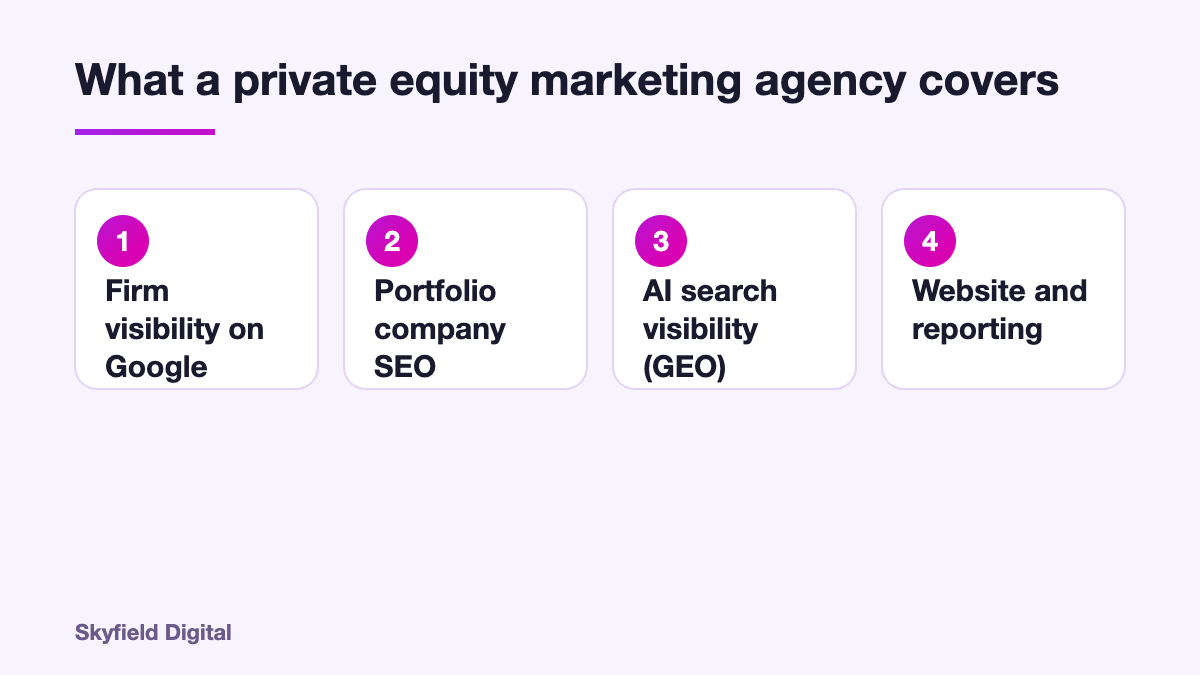
A private equity marketing agency helps a PE firm and its portfolio companies get found by founders, intermediaries, investors and customers. The best fit combines SEO, AI search visibility (GEO) and a website built to convert, with reporting that lets partners compare every holding. Skyfield Digital offers that combination for firms, acquisition groups and portfolio companies.
What a Private Equity Marketing Agency Does
A private equity marketing agency helps a firm and the companies it owns get found, trusted and chosen. For the firm, that means being visible to founders considering a sale, intermediaries building buyer lists and investors doing diligence. For each portfolio company, it means producing leads, orders or bookings in its own market.
The work sits between brand, search and sales. Some agencies lean toward design and events. Others lean toward performance channels. The right private equity marketing agency for you depends on which problem is costing you the most today.
Search is the channel that compounds. Rankings and AI citations built early in a hold period keep working through exit, and a buyer can verify them in the numbers.
Who a Private Equity Marketing Agency Serves
The Firm
A firm needs its sector thesis, team, portfolio and approach to be easy for search engines and AI assistants to read. Founders search for firms by sector and region. Intermediaries check who already has a platform in a category. If your site describes investment criteria in a single paragraph, none of those searches will find you.
A good private equity marketing agency therefore starts with pages built for the way people actually search, plus consistent entity data so ChatGPT, Gemini and Perplexity describe the firm correctly.
Portfolio Companies
Every acquisition arrives with its own website, its own agency and its own level of technical health. At the portfolio level, a private equity marketing agency sets one standard, audits each company, builds a roadmap for its market and reports in one format so operating partners can compare results.
Without that structure, partners spend their time managing vendors instead of creating value.
Why Search and AI Visibility Come First
Paid channels stop producing when the budget stops. Organic search authority and AI citations do not. A page that ranks keeps earning, and a brand that AI engines recommend keeps getting named.
That second point matters more every year. A growing number of buyers ask an AI assistant who to hire or which firms invest in a sector, then act on the first few names. A private equity marketing agency that treats AI visibility as an afterthought leaves that channel to someone else.
Generative engine optimization, or GEO, builds on SEO. Google’s own guidance says optimizing for its AI features is still SEO, because those features are rooted in the same ranking and quality systems.[1] The foundations are the same: crawlable sites, clear information about the brand and strong, original content. Doing both together is more efficient than doing them one after the other, and any private equity marketing agency worth hiring will plan for both.
What to Look for in a Private Equity Marketing Agency
Use these criteria to compare any private equity marketing agency on your shortlist.
Private equity context. The agency should understand hold periods, add-on acquisitions, exit readiness and the compliance review that firm websites go through. You should not have to explain what a platform company is.
Portfolio capability. Running one site well is not the same as running ten. Ask how the agency onboards a new acquisition, how long it takes and how reporting stays consistent as the portfolio grows.
Both SEO and GEO. Rankings alone no longer tell the full story. The agency should track the prompts your buyers ask across ChatGPT, Gemini, Perplexity, Claude, Copilot and Google AI Overviews, and report where each company appears.
Honest reporting. Numbers should come from your own Google Search Console and GA4 accounts and from tracked AI prompts.[2] Be cautious of reports built on vanity metrics.
Clear pricing. Each company should be scoped on its own, with a plan you can read before the first call.
Website capability. Traffic has to land on a site that loads fast, explains the offer and converts. An agency that can also build and rebuild sites removes a handoff.
Questions to Ask Before You Sign
Ask who will actually do the work and whether any of it is outsourced. Ask to see a sample report and a sample roadmap. Ask how a new acquisition is onboarded and how many weeks pass before work starts.
Ask what the private equity marketing agency will not promise. Nobody can guarantee a ranking or an AI recommendation, and a provider that does is selling certainty it does not have.
Finally, ask who owns the website, the content and the analytics accounts. You should own all three. Twelve-month terms are common in SEO, and it is fair to ask what happens if results lag.
How Skyfield Digital Approaches Private Equity Marketing
Skyfield Digital is an SEO and GEO agency in Meriden, Connecticut, that works as a private equity marketing agency for firms, acquisition groups and their portfolio companies. We run one methodology across every holding, with a roadmap built for each company’s market, monthly execution by a US-based team and a consolidated report for partners.
Every plan tracks prompts across ChatGPT, Gemini, Perplexity, Claude, Copilot and Google AI Overviews. Plans start at $1,500 per month per company, and portfolios of five or more holdings are quoted as one program.[3] Our website team builds the firm site and the portfolio sites to one SEO-ready standard.
Skyfield holds a 5.0 rating from 20 verified Google reviews and is a Semrush Certified Agency Partner.[4] If you want to see where your firm and its holdings stand on Google and in AI answers today, request a free audit from Skyfield Digital.
Frequently Asked Questions
What does a private equity marketing agency cost?
Cost depends on scope. At Skyfield Digital, SEO and GEO plans run from $1,500 to $10,000 per month per company, and portfolios of five or more holdings are quoted as one consolidated program.[3]
How long does it take to see results?
Skyfield’s published guidance is that most clients see measurable movement in 3 to 6 months, while competitive terms can take 6 to 12 months. Technical fixes and AI citations often show up sooner.[3]
Do the firm and the portfolio need different agencies?
Not necessarily. One private equity marketing agency can run the firm’s own search presence and apply a shared standard across every holding, which keeps reporting comparable and reduces vendor overhead.
Is SEO enough on its own?
SEO is the foundation, but buyers now use AI assistants alongside Google. Pairing SEO with GEO and a conversion-ready website covers both.
Sources
All sources were accessed on November 12, 2026.
- Google Search Central. “Optimizing your website for generative AI features on Google Search.” https://developers.google.com/search/docs/fundamentals/ai-optimization-guide
- Google Search Central. “Using Search Console and Google Analytics data for SEO.” https://developers.google.com/search/docs/monitor-debug/google-analytics-search-console
- Skyfield Digital. “SEO & GEO Pricing and Plans.” https://skyfielddigital.com/pricing/
- Skyfield Digital. “SEO & GEO Agency: Rank on Google, Get Cited by AI.” https://skyfielddigital.com/

Founder and CEO, Skyfield Digital
Caleb Hester is the founder and owner of Skyfield Digital, bringing nearly a decade of hands on experience in SEO and digital marketing. He specializes in building search strategies that drive long term visibility, qualified traffic, and measurable growth. Caleb’s approach blends technical SEO, content strategy, and real world business insight to help brands compete and scale in increasingly competitive markets.