 Vantage AI Visibility Tool
On this page
- What Generative Engine Optimization for Private Equity Firms Means
- How AI Assistants Answer Questions About Private Equity Firms
- The Prompts That Matter
- What Generative Engine Optimization for Private Equity Firms Involves
- AI Search for Private Equity Firms and Their Portfolio
- GEO and SEO Work Together
- How Long GEO Takes and What It Cannot Do
- How Skyfield Digital Handles GEO for Private Equity Firms
- Frequently Asked Questions
- Sources
Generative engine optimization for private equity firms is the work of getting a firm and its portfolio companies cited in answers from ChatGPT, Gemini, Perplexity, Claude and Google AI Overviews. It combines clear information about the brand, useful original content and real mentions on sources the engines trust, on top of sound SEO. Skyfield Digital tracks the prompts that matter and reports AI visibility for the firm and each holding.
What Generative Engine Optimization for Private Equity Firms Means
Generative engine optimization for private equity firms, usually shortened to GEO, is the practice of making a firm and its portfolio companies easy for AI assistants to find, understand and recommend. The goal is simple: when someone asks an AI tool a question your firm should answer, your name is in the response.
Traditional SEO gets you ranked in a list of links. GEO gets you named inside a written answer. For a firm that wins business through reputation and referrals, being named in that answer is quickly becoming part of how people build their shortlists. Closing that gap is what generative engine optimization for private equity firms is built to do.
How AI Assistants Answer Questions About Private Equity Firms
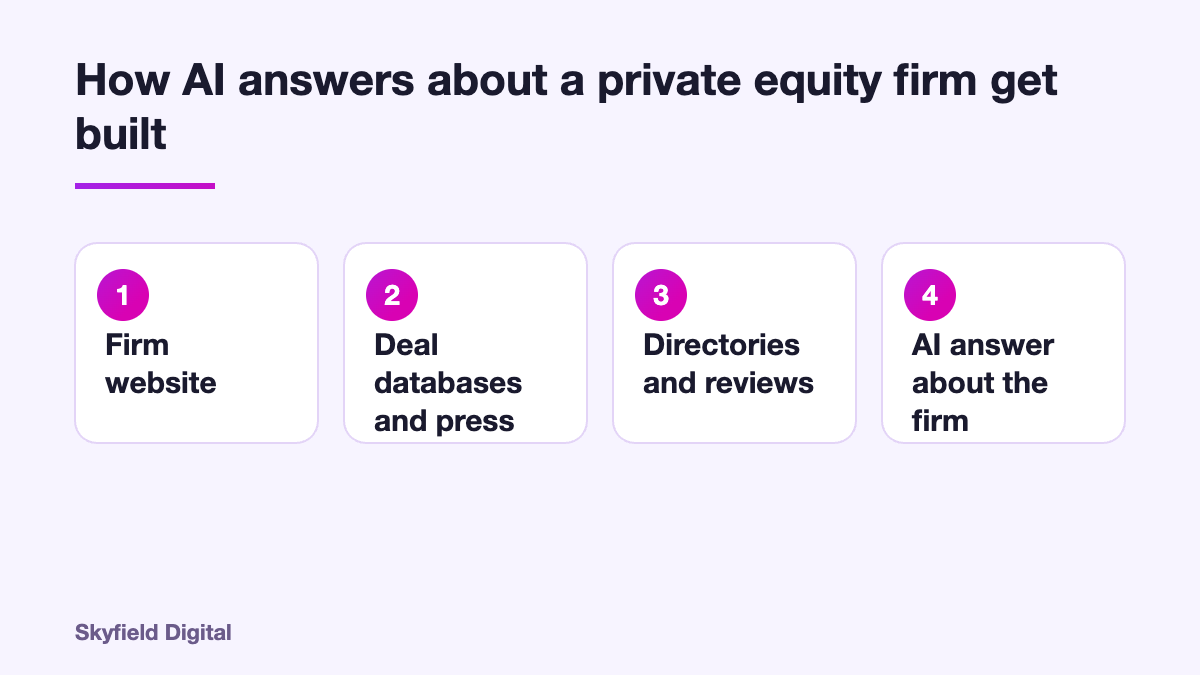
When a founder asks ChatGPT which private equity firms invest in a sector, the answer is assembled from many sources. Deal databases, press releases, the firms’ own websites, LinkedIn data, association directories and news coverage all feed in.
Firms with thin public content tend to be left out, even when they are active. Firms with conflicting information, such as different fund sizes or sector descriptions on different sites, tend to be described vaguely or wrongly. Generative engine optimization for private equity firms fixes both problems at the source.
The Prompts That Matter
Start by listing the questions that should lead to your firm. Founders might ask which firms invest in specialty contractors or which buyers focus on family-owned manufacturers in a region. Intermediaries might ask which firms have a platform in home health. Customers of a portfolio company might ask for the best regional provider of a service.
Each of those questions is a prompt you can track. Run them across ChatGPT, Gemini, Perplexity, Claude, Copilot and Google AI Overviews, record whether the firm appears and note how it is described. That record is your baseline.
What Generative Engine Optimization for Private Equity Firms Involves
Entity Data and Schema
Make the firm’s name, address, sectors, team and portfolio consistent everywhere they appear. Add Organization and related schema markup on the firm’s site. Google says structured data is not required for its AI features, but it remains useful for search overall.[1] An llms.txt file is optional: Google Search ignores it, though other AI tools may read it.[1]
Answer-First Content
Write sector pages and founder resources that lead with the answer. A page that states plainly what the firm invests in, at what size and in which regions is far easier to quote than one that buries it in marketing language.
Third-Party Mentions
AI engines lean on sources outside the firm’s own site. Directories, deal media, industry associations and reviews all count. Generative engine optimization for private equity firms includes building accurate, consistent presence on the sources your sector’s engines trust. Google cautions that chasing inauthentic mentions is not helpful, so the work is earning real coverage and keeping listings accurate.[1]
Sentiment and Accuracy Fixes
When an AI answer is wrong or out of date, trace it to the source. Usually an old profile or conflicting description is feeding it. Correct the source, publish authoritative content and re-check the prompt until the answer improves.
AI Search for Private Equity Firms and Their Portfolio
AI search for private equity firms is not only about the firm. Each portfolio company competes for customers, and AI assistants now recommend providers directly. A company that is missing from those answers loses business to competitors that are cited.
Applying one GEO standard across the portfolio gives every holding the same foundation: consistent entity data, citation-ready content and tracked prompts. Partners then see AI share of voice per company and for the portfolio as a whole.
GEO and SEO Work Together
GEO does not replace SEO. Google’s own guidance treats optimizing for generative AI search as SEO, because its AI features are rooted in the core ranking and quality systems.[1] To appear as a supporting link, a page must be indexed and eligible to show with a snippet.[2] That is why the strongest programs run both together.
Generative engine optimization for private equity firms built on a weak SEO foundation struggles. A site that search engines cannot crawl is also hard for AI engines to read.
How Long GEO Takes and What It Cannot Do
Skyfield’s published guidance is that most clients see measurable movement in 3 to 6 months, and that technical fixes and GEO citations often show up sooner than competitive rankings, which can take 6 to 12 months.[3] With generative engine optimization for private equity firms, the honest answer is that results vary by sector and starting point.
No provider can guarantee a recommendation. AI engines change, and answers vary from one query to the next. What a good program can do is improve the signals, track the results honestly and keep correcting. Google also notes that no third-party tool has access to its internal ranking or AI systems.[1]
How Skyfield Digital Handles GEO for Private Equity Firms
Skyfield Digital is an SEO and GEO agency in Meriden, Connecticut. Our generative engine optimization for private equity firms starts with an AI visibility baseline across ChatGPT, Gemini, Perplexity, Claude, Copilot and Google AI Overviews, then set entity, schema and llms.txt standards, publish citation-ready content and build third-party mentions.
We report AI share of voice per company and for the portfolio, next to rankings and organic traffic. Plans start at $1,500 per month with 10 tracked prompts and scale to 100 or more on the Scale plan, and every plan includes SEO.[3] Request a free audit to see how AI engines answer for your firm today.
Frequently Asked Questions
What is generative engine optimization for private equity firms?
It is the work of getting a private equity firm and its portfolio companies cited and accurately described in AI answers from tools such as ChatGPT, Gemini, Perplexity, Claude and Google AI Overviews.
Does GEO replace SEO for private equity firms?
No. Google’s guidance treats optimizing for AI search as SEO, so the strongest results come from running both together.[1]
How do you measure AI visibility?
We track a fixed set of prompts every month and record whether the brand appears, how it is described and which competitors appear instead. That produces an AI share of voice figure per company and for the portfolio, which is how generative engine optimization for private equity firms is measured month to month. Google also reports traffic from its AI features in the Generative AI performance report in Search Console.[1]
Can generative engine optimization for private equity firms fix what AI says about a firm?
Often, though not always. Inaccurate descriptions usually come from stale or conflicting sources. Correcting those sources and publishing authoritative content can improve the answer over time, but nobody controls what an AI assistant says.
Sources
All sources were accessed on November 12, 2026.
- Google Search Central. “Optimizing your website for generative AI features on Google Search.” https://developers.google.com/search/docs/fundamentals/ai-optimization-guide
- Google Search Central. “AI features and your website.” https://developers.google.com/search/docs/appearance/ai-features
- Skyfield Digital. “SEO & GEO Pricing and Plans.” https://skyfielddigital.com/pricing/

Founder and CEO, Skyfield Digital
Caleb Hester is the founder and owner of Skyfield Digital, bringing nearly a decade of hands on experience in SEO and digital marketing. He specializes in building search strategies that drive long term visibility, qualified traffic, and measurable growth. Caleb’s approach blends technical SEO, content strategy, and real world business insight to help brands compete and scale in increasingly competitive markets.