 Vantage AI Visibility Tool
On this page
- What Private Equity Website Design Has to Accomplish
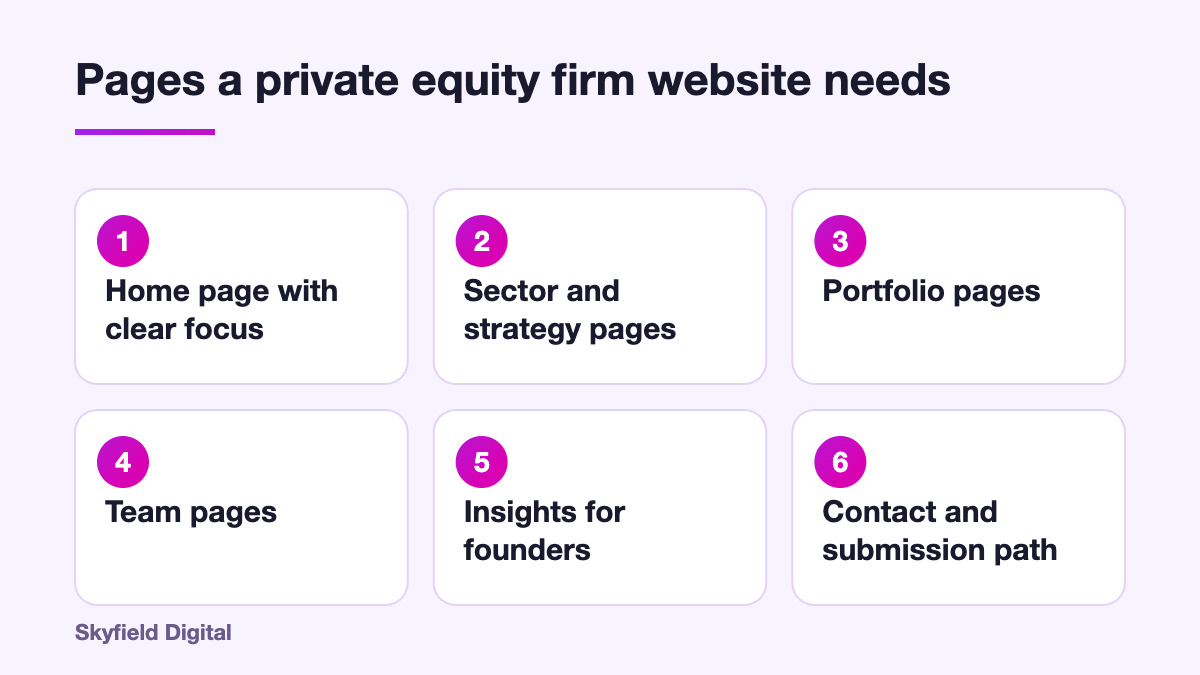
- The Pages a Private Equity Firm Website Needs
- Compliance and Credibility in Private Equity Website Design
- Why Search and AI Visibility Belong in Private Equity Website Design
- Private Equity Firm Website and Portfolio Company Sites
- Common Private Equity Website Design Mistakes
- How Skyfield Digital Approaches Private Equity Website Design
- Frequently Asked Questions
- Sources
Private equity website design has to do four jobs: explain the investment thesis to founders and intermediaries, present the team and portfolio credibly to LPs, meet compliance expectations and rank in Google and AI search. Skyfield Digital builds private equity firm websites and portfolio company sites SEO-ready from launch on WordPress, Shopify, Wix, Drupal or custom builds.
What Private Equity Website Design Has to Accomplish
A private equity firm website is not a brochure. It is the page founders open after a referral, the page an intermediary checks before adding a firm to a buyer list and the page an LP reviews before a meeting. Good private equity website design serves all three without confusing any of them.
That means clear structure, fast pages, honest content and a design that signals competence without shouting. It also means the site has to be found, which is where many firm sites fall short.
The Pages a Private Equity Firm Website Needs
A Home Page That States the Focus
Say who you are, what you invest in and what kind of partner you are within the first screen. Visitors should not have to hunt for the sector or size range.
Sector and Strategy Pages
Give each sector its own page covering criteria, company profile, geography and add-on approach. In private equity website design, these pages do the most work because they match how founders and intermediaries search.
Portfolio Pages
Show each company with a short description, the sector, the partnership dates and a link to its site where appropriate. Keep names and descriptions consistent with press releases and directories.
Team Pages
Give each partner a page with a clear bio and relevant experience. People choose people, and individual pages also support searches for the partners by name.
Insights and Founder Resources
Guides on what to expect from a sale process, how the firm works with management and what it looks for in a business earn trust and links. They also give AI assistants something specific to quote.
Contact and Submission Paths
Make it easy for founders and intermediaries to reach the right person. A short form with clear expectations works better than a generic inbox.
Compliance and Credibility in Private Equity Website Design
Firm sites often go through legal review for performance claims, testimonials and descriptions that could be read as an offer. Plan for that from the start. Build templates that make disclosures easy to place where they are needed, and keep a clear approval path for new content.
Follow your counsel’s guidance on what can be published. A site that is accurate and compliant is more credible than one that overreaches.
Why Search and AI Visibility Belong in Private Equity Website Design
Many firm sites look polished and rank for nothing. The thesis sits in one paragraph, the portfolio is a grid of logos and the team pages carry no text. Search engines have little to read, and AI assistants have little to quote.
Build search into the design from the first wireframe. Use real headings, descriptive page titles, schema markup and internal links between sectors, portfolio companies and insights. Add Organization data so engines understand who the firm is.[3]
Google says the same SEO fundamentals apply to its AI features: pages must be crawlable and indexed, and important content should be available as text.[4] When a founder asks an AI assistant which firms invest in a sector, clear, well-organized pages give the assistant something accurate to use.
In practice, private equity website design projects should start with a content plan and an SEO plan, not a template. Decide the sector pages, the search terms for each and the schema types before any visual work begins. Working in that order avoids a second rebuild six months later.
Private Equity Firm Website and Portfolio Company Sites
A private equity firm website is only one part of the picture. Each portfolio company needs a site that converts leads, orders or bookings in its own market. Acquisitions often arrive with outdated sites, weak speed scores and missing schema.
Rebuilding those sites to one standard saves time on every future acquisition. It also makes reporting consistent, so partners can see which companies have digital traction. When a site is rebuilt, the migration should preserve existing rankings by mapping old URLs to new ones.[2]
Common Private Equity Website Design Mistakes
Style over substance. A beautiful site with no sector detail does not answer a founder’s questions.
Slow pages. Heavy images and scripts frustrate visitors and can weaken page experience signals.[1]
Hidden content. Text inside images or tabs that never load is invisible to search engines.
Designing before planning. Private equity website design that starts with a template instead of a content map usually ends in a second redesign.
No measurement. Without analytics and Search Console connected, nobody knows whether the site is working.
How Skyfield Digital Approaches Private Equity Website Design
Skyfield Digital is an SEO, GEO and website development agency in Meriden, Connecticut. We build firm sites and portfolio company sites on WordPress, Shopify, Wix, Drupal and custom stacks, with speed, schema and analytics set up from day one.[5]
For redesigns, we protect existing rankings through careful migration planning. For new acquisitions, we run the same audit and build process every time. Because the same team handles SEO and GEO, the website launches ready to be found on Google and cited in AI answers.
Request a free audit from Skyfield Digital to see how your current site performs.
Frequently Asked Questions
What should a private equity firm website include?
A clear statement of focus, sector pages, portfolio pages, partner pages, insights for founders and a simple contact path, all with compliance-ready placement for disclosures.
Can a redesign hurt our rankings?
It can if URLs, titles and content change without a plan. A migration that maps old pages to new ones and keeps what already ranks protects existing visibility.[2]
Which platform is best for private equity website design?
The right platform depends on your team and content needs. WordPress is common for firms that publish regularly. Skyfield builds on WordPress, Shopify, Wix, Drupal and custom stacks.
How much does private equity website design cost?
Cost depends on page count, integrations and content readiness. Skyfield scopes every build individually, and a free audit is a good starting point for estimating what your current site needs.
How long does a firm website take to build?
Timelines depend on page count and content readiness. Planning the sector pages and compliance review early is the biggest factor in keeping a project on schedule.
Sources
All sources were accessed on November 12, 2026.
- Google Search Central. “Core Web Vitals.” https://developers.google.com/search/docs/appearance/core-web-vitals
- Google Search Central. “Move a site with URL changes.” https://developers.google.com/search/docs/crawling-indexing/site-move-with-url-changes
- Google Search Central. “Organization structured data.” https://developers.google.com/search/docs/appearance/structured-data/organization
- Google Search Central. “Optimizing your website for generative AI features on Google Search.” https://developers.google.com/search/docs/fundamentals/ai-optimization-guide
- Skyfield Digital. “SEO & GEO Agency: Rank on Google, Get Cited by AI.” https://skyfielddigital.com/

Founder and CEO, Skyfield Digital
Caleb Hester is the founder and owner of Skyfield Digital, bringing nearly a decade of hands on experience in SEO and digital marketing. He specializes in building search strategies that drive long term visibility, qualified traffic, and measurable growth. Caleb’s approach blends technical SEO, content strategy, and real world business insight to help brands compete and scale in increasingly competitive markets.