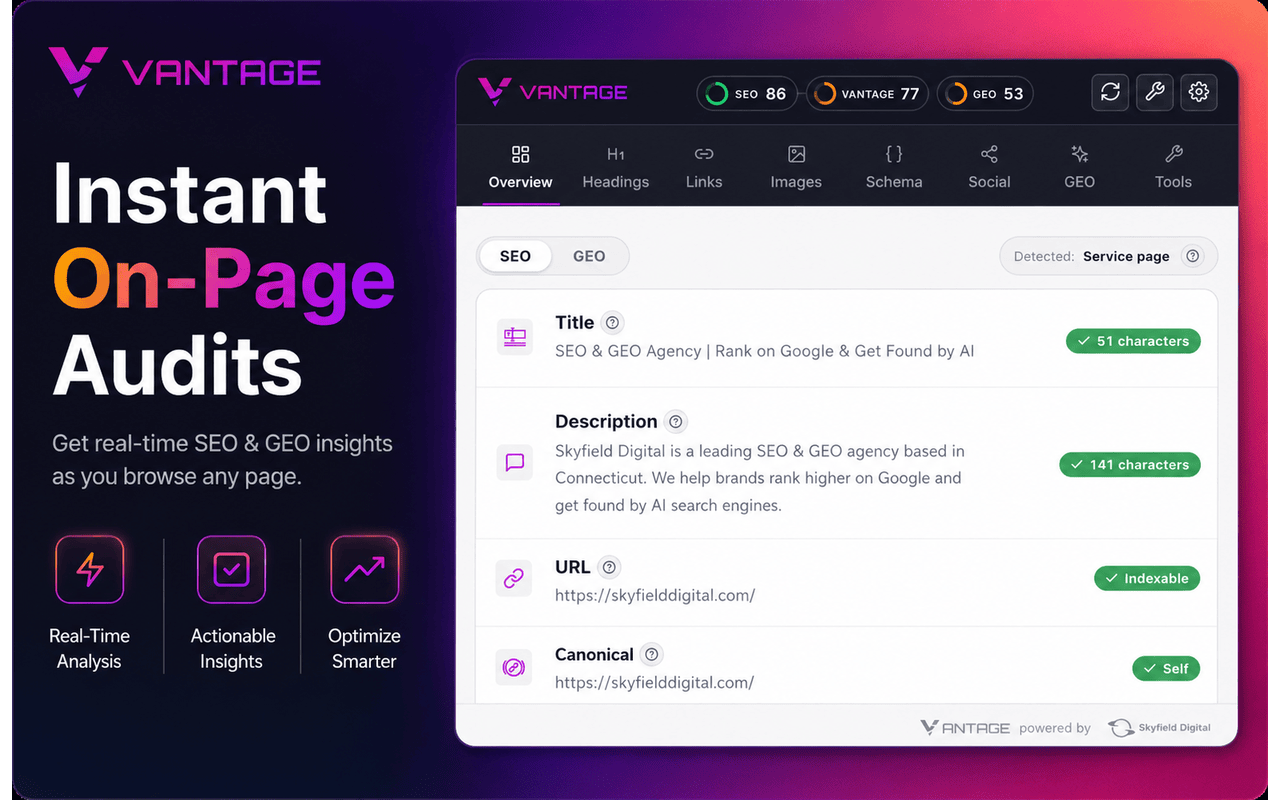
Vantage is a free browser extension for Chrome and Firefox from Skyfield Digital that audits any page for both traditional SEO and GEO, generative engine optimization, in a single pass. It runs 77 weighted checks across 10 rule categories and returns three scores, an SEO score, a GEO score, and a combined Vantage score, each on a 0 to 100 scale. It also folds a dozen separate tools, a heading mapper, a JSON-LD schema generator, a device simulator, and more, into one extension. Every check runs locally in the browser, nothing is sent to a server, and no account is required.
A marketer opens a page that sits in the third spot on Google for its target keyword and feels good about it, then types the same question into ChatGPT and watches three other sites get cited by name while their own page never comes up. Nothing about the page changed. The ranking is still there. The issue is that a page built to satisfy a search engine’s crawler and a page built to be quoted by a language model are not automatically the same document, and most SEO tools were never built to check for the second one.
Skyfield Digital built Vantage to close that gap. It is a free browser extension that checks a page the way a search engine reads it and the way an AI answer engine reads it, in the same pass, without an account and without sending any data off the page. This article walks through what Vantage actually does, how its GEO scoring works, what is packed inside the extension, and how to start using it as part of a broader SEO and GEO strategy.
What Is Vantage, and Why Did Skyfield Digital Build It?
Vantage is a free browser extension for Chrome and Firefox that audits whatever page you’re viewing against both classic SEO standards and GEO standards in one pass. The idea behind it is straightforward: see your site the way search engines and AI answer engines actually see it, instead of guessing.
Most SEO extensions were built for a search landscape with one kind of reader, a crawler. Vantage was built for a landscape with two: the crawler that indexes a page for Google, and the retrieval systems behind ChatGPT, Gemini, Claude, and Perplexity that pull fragments of a page into a generated answer. Instead of asking marketers to bounce between a heading mapper, a screenshot tool, a color picker, a keyword density checker, and a classic SEO toolbar, Vantage folds all of it into a single extension and adds a GEO scoring layer on top of the SEO checks those tools already handled.
Why Isn’t a Strong Google Ranking Enough Anymore?
A page can hold a top position on Google and still be invisible inside an AI-generated answer, because ranking and citation are solved by two different systems with two different rule sets. Google’s algorithm sorts pages into an ordered list. An AI answer engine pulls fragments from several pages at once, checks how confidently it can extract a clean fact from each one, and stitches the strongest fragments into a single response.
That means a page optimized only for the first system can quietly fail the second one, and most site owners have no way of knowing it is happening, since there is no dashboard that flags a missed AI citation the way Search Console flags a ranking drop. Vantage was built to surface that gap directly on the page, before a competitor’s clearer, more extractable content wins the citation instead.
How Does Vantage Score a Page for SEO and GEO?
Every audit runs 77 weighted checks spread across 10 rule categories, covering standard technical and on-page SEO factors alongside a dedicated GEO layer. The result is three separate scores, an SEO score, a GEO score, and a combined Vantage score, each expressed on a 0 to 100 scale, so it is easy to see at a glance where a page is strong and where it is exposed.
The GEO score is built around three weighted factors that determine how easily ChatGPT, Gemini, Claude, and Perplexity can extract and cite a page’s content.
| GEO Factor | Weight | What It Measures |
|---|---|---|
| Specificity | 40% | Whether claims are concrete and verifiable rather than vague or generic |
| Extractability | 35% | How cleanly a direct answer can be pulled from a section without extra parsing |
| Authority | 25% | Signals that support trusting the source enough to cite it |
Weighting specificity the heaviest of the three reflects what actually seems to drive AI citations. Vague, hedged language tends to get passed over in favor of content that states something precise enough to quote directly.
What’s Actually Packed Inside the Extension?
Vantage consolidates twelve tools into a single install, covering both the audit side and the day-to-day tasks that usually require separate downloads.
- SEO and GEO audit with a combined 0 to 100 score
- GEO scoring broken into extractability, specificity, and authority
- Heading map to check heading structure and hierarchy at a glance
- JSON-LD schema generator for structured data
- Social preview checker for Facebook, X, LinkedIn, Discord, and Slack
- Full-page screenshot editor with annotation tools
- Device simulator with 61 screen presets
- User-agent switcher, including a GPTBot preset
- Keyword density analyzer
- Color picker
- Right-click utilities for quick page checks
- People Also Ask extraction
As an illustrative example, a marketer running four of those checks separately today, a heading mapper, a keyword density tool, a screenshot annotator, and a basic SEO toolbar, might reasonably be paying somewhere in the 15 to 25 dollar a month range across those subscriptions, depending on the tools chosen. Vantage replaces that stack at no cost, without changing what actually gets checked on the page.
Why Does Vantage Run Entirely Locally, With Zero Data Collected?
Every check runs inside the browser, on the page currently open. No page content, no URLs, and no usage data are sent to a server, and there is no account required to install or use any part of it.
Vantage runs its full SEO and GEO audit locally in the browser. Nothing about the page you’re checking, or the fact that you checked it, ever leaves your device.
That local-only design matters most for anyone auditing client sites, pre-launch pages, or internal tools that shouldn’t be pinged by a third-party server just to get a heading structure or a meta tag reviewed.
Who Should Be Using Vantage?
In-house marketers and content teams get the fastest read on whether a page is ready to publish, on both the SEO and GEO side, without switching tabs. Agencies and freelance SEOs get a quick first pass on a new site before a deeper audit. Dev and QA teams get real, daily use out of the screenshot editor and 61-device simulator when checking a page before it goes live, and the social preview checker earns its place for anyone who also owns social media management and needs a page to look right the moment it’s shared.
Vantage is free and built for fast, ongoing checks. Teams that want the deeper version of that work, a full technical SEO program, or a site rebuild that’s structured correctly from the website development stage forward, are exactly who Skyfield Digital’s broader services are built for. Vantage tells you what’s happening on a page. Those services are for fixing it at scale.
What Do Most Teams Get Wrong When They Start Optimizing for AI Search?
The common shortcut is treating GEO as a quick add-on, dropping FAQ schema onto a few pages and calling it done. That helps at the margins, but it skips the part that actually changes whether a model cites the page, restructuring each section so it leads with a direct, specific answer instead of building up to one.
The second mistake is checking only one AI platform and assuming the result holds everywhere. ChatGPT, Gemini, Claude, and Perplexity each retrieve content differently, so a page can score well for one and poorly for another. Vantage’s GEO score is built around signals that tend to matter across all of them, extractability, specificity, and authority, rather than chasing a single model’s quirks.
Adding schema to a handful of pages is a checklist item. Rewriting how each section states its answer is the part that actually changes what a language model can quote.
How Should You Start Tracking SEO and GEO Together?
Treat the three Vantage scores, SEO, GEO, and combined, as a baseline to check before publishing anything new, then re-check on a schedule rather than once. A page that scored well six months ago can slip as competitors publish clearer, more extractable content on the same topic.
Pair the score with real testing. Running a page’s target query through ChatGPT, Gemini, and Perplexity periodically shows whether a strong GEO score is actually converting into citations, since the score is a proxy for extractability, not a guarantee of it. Teams running a broader GEO program often build this into a monthly review alongside standard ranking checks.
Frequently Asked Questions
Is Vantage really free to use?
Yes. Vantage is free to install and use on both Chrome and Firefox, with no premium tier or paywalled features.
Do I need to create an account to use it?
No. Vantage runs directly in the browser and doesn’t require sign-up or login to use any of its tools.
What does the GEO score actually measure?
It measures how easily AI answer engines like ChatGPT, Gemini, Claude, and Perplexity can extract and cite a page’s content, based on three weighted factors: specificity, extractability, and authority.
Does Vantage send any of my browsing or page data to a server?
No. Every check runs locally in the browser on the page you’re viewing, and Vantage collects zero data.
Can Vantage replace a full SEO or GEO audit from an agency?
Vantage is built for fast, ongoing checks rather than a full strategic audit. It’s a strong first pass and a good daily-use tool, but a deeper technical SEO or GEO program still benefits from a dedicated audit that looks at the whole site rather than one page at a time.
How is Vantage different from a typical SEO toolbar?
Most SEO toolbars only check traditional ranking factors. Vantage checks those same factors and adds a GEO score on top, along with tools like a device simulator, a screenshot editor, and a social preview checker that usually require separate extensions.
Which browsers does Vantage support?
Vantage is currently available for Chrome and Firefox.
Install Vantage free and check your next page against 77 SEO and GEO signals before you hit publish.
Sources
| OpenAI Help Center | ChatGPT Search |
| Perplexity Help Center | How Does Perplexity Work? |
| Google Search Central | Understand How Structured Data Works |
| Search Engine Land | Mastering Generative Engine Optimization in 2026 |