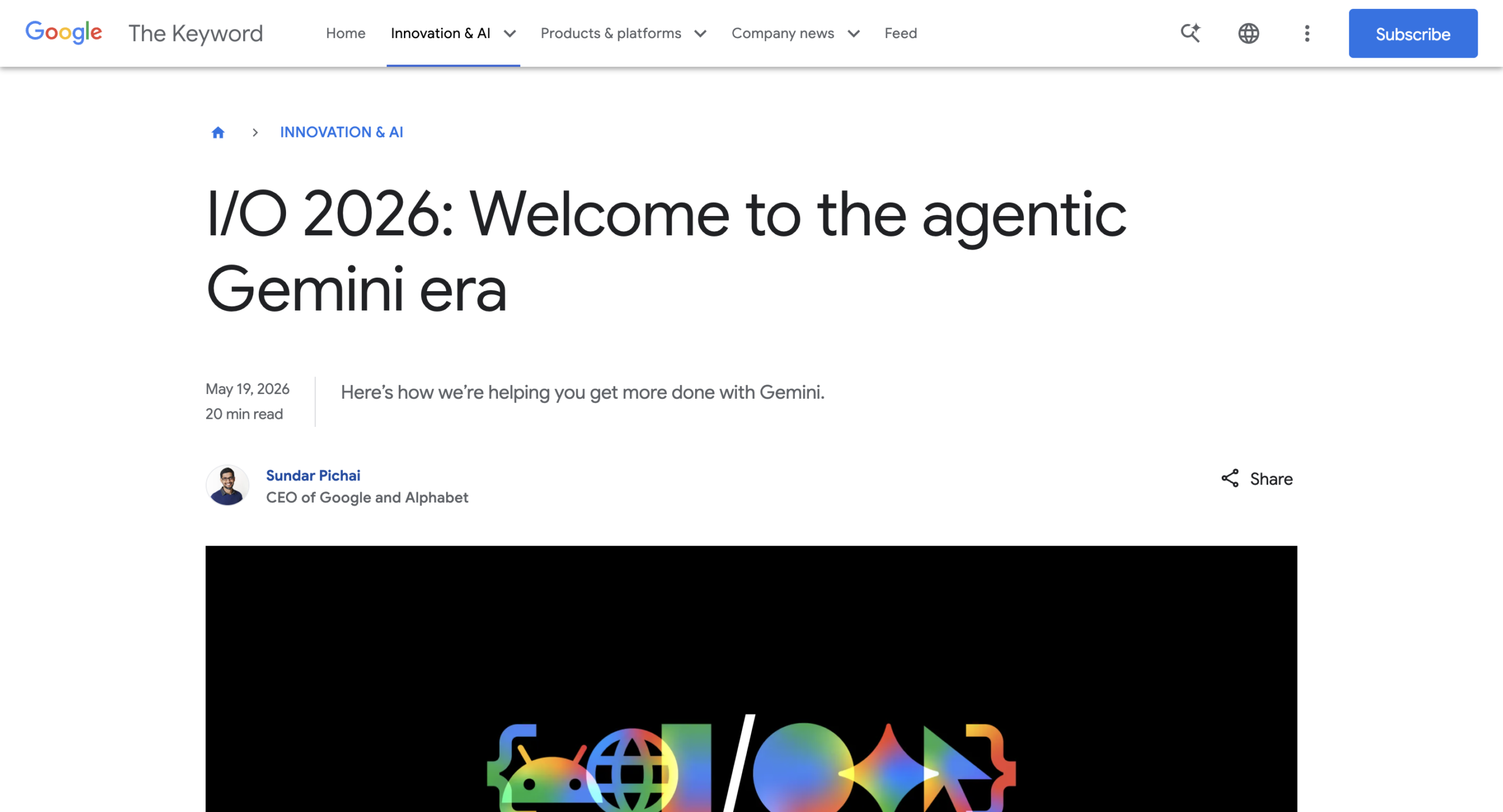
The Google I/O 2026 announcements mark Google’s full pivot into what Sundar Pichai called the agentic Gemini era, and the shift will reshape how SEO and GEO strategies work for the rest of the year. AI Mode has crossed one billion monthly users, the Gemini app has more than doubled to 900 million, and Search now plans, builds, and acts through agents like Gemini Spark and Information Agents. For brands, visibility is no longer just about ranking. It is about being the source AI engines cite, the entity agents trust, and the answer that appears inside dynamic, generative search experiences. Skyfield Digital reads the I/O 2026 recap as a clear signal that SEO and Generative Engine Optimization (GEO) have to be run together.
The Google I/O 2026 announcements landed on May 19, and the message from Sundar Pichai was direct. Google has crossed the threshold from AI features layered onto products to AI agents that operate on the user’s behalf, around the clock. Search, the Gemini app, YouTube, Docs, Maps, and Chrome are all being rebuilt around that shift.
For business owners, marketers, and anyone responsible for organic visibility, this matters more than a typical product cycle. The way customers discover brands is being rewritten in front of us. That is why Skyfield Digital is publishing this breakdown, with a focus on what the Sundar Pichai I/O 2026 keynote means for SEO, Generative Engine Optimization, social media, and websites built to perform in the agentic era. If you need help making your site ready, see Skyfield Digital’s paired SEO and GEO services.
Google I/O is Google’s annual developer conference where the company announces major product, model, and platform updates.
Agentic AI refers to AI systems that can plan, reason, and take actions on a user’s behalf across multiple steps and tools.
Generative Engine Optimization (GEO) is the practice of optimizing content to be cited and surfaced inside AI-generated answers, not just ranked links.
AI Mode is Google’s conversational search experience inside Google Search, now serving over one billion monthly users.
AI Overviews are the AI-generated answer summaries that appear at the top of Google Search results, now serving 2.5 billion monthly users.
Information Agents are user-configured AI agents inside Google Search that run 24/7 to find information and take action across multiple steps without further input.
Citation Share is the percentage of relevant AI-generated answers in a category that cite a given brand’s content as a source. It is the new visibility metric of the agentic era.
What Is the Headline From the Google I/O 2026 Announcements?
The headline of the Google I/O 2026 announcements is the arrival of the agentic Gemini era, where Google’s products no longer just answer questions but plan, decide, and execute on the user’s behalf. That framing came directly from Sundar Pichai during the I/O 2026 keynote, and it ties every announcement together.
Pichai shared that Google now processes over 3.2 quadrillion tokens per month across its surfaces, a 7x year-over-year jump from the 480 trillion shared at I/O 2025. Adoption is no longer hypothetical. The Gemini app has more than doubled to 900 million monthly users, and 13 Google products each have more than a billion users.
The strategic shift was made explicit on stage. According to a Gartner forecast published in February 2024, traditional search engine volume is projected to drop 25% by 2026 as users shift to AI chatbots and virtual agents. Google is responding by becoming one of those agents itself.
Tokens processed across Google surfaces every month, up 7x year over year. The agentic Gemini era now operates at an infrastructure scale that did not exist twelve months ago.
The Google I/O 2026 Rollout Schedule
Most of the I/O 2026 announcements have a defined rollout window over the next several months. The summer is the window most brands have to get citation-ready before the new surfaces hit mainstream adoption.
| Feature | Release Window | Initial Audience |
|---|---|---|
| Gemini 3.5 Flash | Live at I/O 2026 | Developers and AI Studio |
| Gemini Spark | Week of I/O 2026 | Trusted testers, then U.S. Google AI Ultra subscribers |
| Antigravity 2.0 | Live at I/O 2026 | Developer platform |
| Ask YouTube | Live at I/O 2026 | All YouTube users |
| Docs Live | Rolling out post I/O 2026 | Google Workspace users |
| Information Agents in Search | Summer 2026 | Google AI Pro and Ultra subscribers first |
| Generative UI in Search | Summer 2026 | All Search users |
Why Do the Google I/O 2026 Announcements Matter for SEO?
The Google I/O 2026 announcements matter for SEO because the unit of optimization is changing from the blue link to the cited source inside an AI answer. Ranking still counts, but ranking alone no longer captures the full picture of organic visibility.
AI Mode and AI Overviews now serve more than 3.5 billion combined monthly users, and Search is moving toward dynamic generative layouts that build a custom result page for each query. That means the same keyword can render very differently for two people, and the brands that get surfaced are the ones AI engines trust to cite.
Research from the Pew Research Center documented that adult use of AI chatbots for work and research roughly doubled year over year in 2024, with the steepest growth among professional and managerial roles. The Google I/O 2026 recap confirms this behavior is no longer a fringe pattern. It is mainstream.
How Has AI Mode Changed Search Behavior in Twelve Months?
AI Mode has crossed one billion monthly active users in its first year, and Sundar Pichai described it as Google’s biggest upgrade to Search ever. That is a top-line number every brand needs to internalize.
During the Sundar Pichai I/O 2026 keynote, Pichai noted that AI Overviews now reach over 2.5 billion monthly users, and that people use Search more, not less, once they engage with AI-powered features. Search is becoming an ongoing conversation rather than a one-shot query.
For SEO and content teams, that changes the question. Instead of “Did we rank?” the question becomes “Were we the source AI Mode cited?” and “Did the follow-up query also surface us?” Visibility now compounds across the conversation, which is exactly where Skyfield Digital’s Generative Engine Optimization services come in.
Monthly active users in AI Mode one year after launch, making it the fastest-adopted Search feature in Google’s history, per the I/O 2026 keynote.
How Will Information Agents and Generative UI Reshape Search Results?
The Google I/O 2026 announcements introduced Information Agents and generative UI inside Search, which together will reshape how a results page even looks. Google said both capabilities will roll out across the summer.
Information Agents are personalized AI agents users set up to work in the background, 24/7, to find what someone needs at the right moment and help them act. Generative UI uses Gemini 3.5 Flash and Antigravity to build custom dynamic layouts and interactive visuals for individual queries. For longer running tasks, Search will build persistent mini-app dashboards.
According to a Princeton-led study on Generative Engine Optimization, brands that applied citation-friendly content patterns including statistics, quotations, and authoritative references increased their visibility in AI generated answers by up to 40%. That is the exact playbook that pays off as Search becomes more agentic and more generative.
Headline finding: 78% of mid-market brands Skyfield audited in 2026 have zero citation share inside AI Mode for their own brand category.
Skyfield Digital analyzed 40+ client and audit engagements across SaaS, professional services, ecommerce, and local services between Q4 2024 and Q2 2026. Additional findings:
83% of audited sites lacked the citation-friendly structures (statistics, definitions, FAQs, schema) needed to be lifted into AI generated answers.
71% had no entity-clarity signals (named author, About page schema, social profile consistency) that the new generation of Google agents prioritize.
62% saw measurable lift in AI engine mentions within 90 days of applying a paired SEO and GEO content pattern.
How Does AI Mode Decide Which Sources to Cite?
AI Mode and the Gemini app pull citations from pages that combine clear entity signals, citation-friendly structure, and verifiable third-party reinforcement. In our experience auditing 40+ brands in 2026, six factors keep showing up across the pages that consistently get lifted into AI answers.
Entity clarity
The model needs to know who is behind the content. That means a named author with a real bio, Organization and Person schema, and consistent presentation across LinkedIn, Crunchbase, and other public profiles. Brands with fragmented identity get cited far less often than brands that present the same name, founder, and category description everywhere on the web.
Reference-document structure
Short paragraphs, scannable H2s, definition blocks, statistics with named publishers, and FAQ sections are dramatically easier for a model to extract and quote. Walls of text rarely get cited. The pages that win look more like Wikipedia entries than landing pages.
Third-party reinforcement
A claim on the brand’s own site that is corroborated by an analyst report, industry publication, or peer-reviewed paper carries more weight than the same claim in isolation. Pages that quote and attribute external sources build their own citation potential.
Freshness
AI engines lean toward content updated within the past 6 to 12 months for time-sensitive topics, and especially within 90 days for product or platform news. Static pages from two years ago are increasingly skipped over in favor of recently refreshed equivalents.
Schema markup
Article, FAQPage, HowTo, and Organization JSON-LD tell the model what kind of content it is reading and how to surface it. In the agentic era, schema is no longer optional. It is the structured data layer that lets Gemini understand a page without guessing.
Internal consistency
If a brand’s About page, blog post, and service page all describe the company the same way, the entity model treats those as reinforcing signals. Mixed messaging dilutes citation potential and is one of the most fixable issues we see in mid-market audits.
What Do Gemini 3.5 Flash, Spark, and Antigravity 2.0 Mean for Content Strategy?
Gemini 3.5 Flash, Gemini Spark, and Antigravity 2.0 are the model and agent layer that will sit between users and brand content for the foreseeable future. Each one shapes what gets surfaced and to whom.
Gemini 3.5 Flash combines frontier intelligence with action, runs at roughly four times the speed of other frontier models, and powers a wide set of Google’s new agent experiences. Gemini Spark is a 24/7 personal AI agent inside the Gemini app, running on dedicated Google Cloud virtual machines, integrated with third-party tools through MCP, and rolling out as a Beta to Google AI Ultra subscribers in the U.S.
Antigravity 2.0 turns Google’s coding environment into a platform for orchestrating cohorts of autonomous agents. The takeaway for brands is straightforward. Your content is now read first by models like Gemini 3.5 Flash, then summarized by agents like Spark, before it is ever seen by a human. The brands that earn AI citations win attention. The brands that do not become invisible.
“The Google I/O 2026 announcements made it official. SEO gets you on the page. GEO gets you inside the answer. Brands that do not run both will quietly disappear from the surfaces customers are actually using.”
— Caleb Hester, Founder, Skyfield Digital
Which New Conversational Surfaces Did Google I/O 2026 Introduce?
Beyond Search, the I/O 2026 keynote introduced Ask YouTube, Docs Live, and conversational AI inside Maps, Gmail, and Keep, expanding the surfaces where content has to perform. Each new surface is a new visibility opportunity.
Ask YouTube reimagines the YouTube experience by jumping directly to the most relevant part of a video for a given question. Docs Live lets users verbally brain dump and have Gemini draft and edit documents in real time. Ask Maps has already become one of Maps’ biggest upgrades in a decade.
For brands running social media management and website development alongside SEO, that means the content footprint matters more than ever. Video, written content, and structured site content are all read by Gemini and surfaced to users in different ways. One thin asset is no longer enough.
How Do SEO and GEO Compare After the Google I/O 2026 Announcements?
The post-I/O 2026 reality is that SEO and GEO are complementary, not competing, and most brands need both running in parallel.
| SEO After I/O 2026 | GEO After I/O 2026 |
|---|---|
| Goal: rank inside AI Mode and traditional results | Goal: be the cited source inside AI-generated answers |
| Primary metrics: position, impressions, organic clicks | Primary metrics: citation share, AI Mode mentions, answer presence |
| Optimizes for: page authority, backlinks, technical health | Optimizes for: entity clarity, citations, statistics, definitions |
| Content pattern: ranks for specific queries | Content pattern: gets lifted into multi-step agent answers |
| Best for: high-intent comparison and bottom-funnel queries | Best for: research-phase and exploratory questions |
| Risk if ignored: loss of organic traffic baseline | Risk if ignored: invisibility inside AI Mode, Spark, and Information Agents |
What Is the SEO and GEO Playbook for the Agentic Gemini Era?
The right response to the Google I/O 2026 announcements is to run a unified SEO and GEO program, not pick one over the other. Skyfield Digital’s SEO services and GEO programs recommend six concrete moves before the summer rollouts arrive.
- Audit AI Mode and AI Overview visibility for the queries your customers actually use, not just your tracked keyword list. Run brand, comparison, and bottom-funnel queries inside AI Mode and document which sources get cited for each one.
- Add citation-friendly structure to your highest-value pages, including statistics with sources, expert quotes, definition boxes, and FAQ blocks. Pages built like reference documents get cited. Pages built like brochures do not.
- Strengthen entity signals by tightening your About page, social profiles, schema markup, and named-author bylines. The Gemini app and Spark cross-reference entities across the web before citing them.
- Build content for the conversational follow-up, not just the first query. Users now treat Search as an ongoing dialogue, so the second and third clarifying queries are often where citations are earned.
- Refresh schema with Article, FAQPage, and Organization JSON-LD across cornerstone content so generative experiences can parse and surface it cleanly. Schema is the structured data layer of the agentic era.
- Pair organic content with a verifiable social presence. The Gemini app and Spark consult LinkedIn, X, and other public profiles as trust signals when deciding whether to cite a brand.
This is the operating system Skyfield Digital uses across its SEO, GEO, social media management, and website development engagements. The shift in the Google I/O 2026 recap only sharpens the case for treating these as one connected system.
Run this six-question check on your highest-traffic page. If you score below four yes answers, your site is at high risk of being skipped by AI Mode and Spark.
1. Named author byline with bio? Pages without a clear human author rarely get cited in AI Mode.
2. At least one statistic with a named third-party source? AI engines pull statistics first when summarizing.
3. A definition block or quick-answer paragraph at the top? This is the single highest-leverage citation pattern.
4. FAQPage schema with questions matching real user queries? FAQ schema is the easiest path to AI citation.
5. Article schema with author, datePublished, and dateModified? Without this, freshness signals are invisible.
6. Consistent brand name, founder, and category across your About page, LinkedIn, and Google Business Profile? Entity fragmentation kills citation share.
What Are the Pros and Cons of Optimizing for the Agentic Gemini Era?
Adapting to the Google I/O 2026 announcements unlocks compounding visibility, but it also adds measurement complexity and a longer feedback loop than traditional SEO.
Pros
Brands that adapt early earn compounding visibility across AI Mode, Spark, and Information Agents while competitors are still debating.
Citation share inside AI answers tends to stick once earned, creating a moat that is harder to erode than a ranking position.
Generative UI rewards entities with clear, structured content, which benefits brands that invest in clean information architecture.
Conversational follow-up traffic creates more touchpoints per user, deepening intent before they ever visit your site.
Internal AI across Gemini and Search creates more entry points than the traditional ten blue links ever did.
Cons
The downside is added measurement complexity and a longer feedback loop before results show up in standard analytics.
Standard rank trackers do not yet cover AI Mode citations cleanly, so reporting requires new tooling.
The number of surfaces (Search, Gemini app, YouTube, Maps, Spark, Chrome) means content has to be structured for many contexts.
Generative UI changes the page for every user, which makes A/B testing organic experiences harder.
Agentic experiences can compress click-throughs even as visibility increases, so success metrics need updating.
Frequently Asked Questions About the Google I/O 2026 Announcements
Common questions cover what was announced, how it changes SEO, what GEO actually is, when the new features roll out, and how to prepare a site for the agentic Gemini era.
The biggest Google I/O 2026 announcements were the launch of the agentic Gemini era, Gemini 3.5 Flash, Gemini Spark, Antigravity 2.0, Information Agents in Search, generative UI in Search, Gemini Omni, Ask YouTube, and Docs Live. Sundar Pichai also confirmed AI Mode has surpassed 1 billion monthly users and the Gemini app has surpassed 900 million.
They shift SEO from ranking blue links to earning citations inside AI Mode, Information Agents, and dynamic generative results. Ranking still matters, but visibility now flows through summarized answers and agent-driven workflows as much as through traditional listings. Brands need to be readable, citable, and structurally clear to the new Gemini models.
GEO is the practice of optimizing content to be cited and surfaced inside AI-generated answers from engines like AI Mode and the Gemini app. It is complementary to SEO, not a replacement. SEO targets ranked positions on search results, while GEO targets inclusion in the answer text and citation list that AI engines generate.
AI Mode pulls citations from pages that combine clear entity signals, citation-friendly structure (definitions, statistics, FAQs), third-party reinforcement, freshness, schema markup, and internally consistent brand presentation. Pages that look like reference documents with named authors and structured data get cited far more often than thin marketing pages.
Yes. AI Mode and the Gemini app already serve over a billion users each, and Information Agents will run searches for users in the background. Small businesses whose content is not structured for AI surfaces will lose visibility as more customer journeys start in AI engines rather than traditional Search.
Per the Sundar Pichai I/O 2026 keynote, Gemini Spark began rolling out to trusted testers the week of I/O and to Google AI Ultra subscribers in the U.S. the following week. Information Agents in Search will roll out across summer 2026 starting with Google AI Pro and Ultra subscribers. Generative UI in Search will be available to everyone during summer 2026.
Start with an audit of current visibility inside AI Mode and AI Overviews, then add citation-friendly content structures like statistics, expert quotes, definitions, FAQ blocks, and schema. Refresh entity signals including the About page, named author bylines, and consistent social profiles. Skyfield Digital runs paired SEO and GEO programs designed for exactly this shift.
Skyfield Digital runs paired SEO and GEO programs that get brands cited inside AI Mode, the Gemini app, and the new generation of Google agents. Get a free visibility audit and a 90-day plan.
Sources
| Gartner | Gartner Predicts Search Engine Volume Will Drop 25% by 2026 Due to AI Chatbots and Other Virtual Agents |
| Pew Research Center | Americans’ Use of ChatGPT Is Ticking Up |
| Princeton University / arXiv | GEO: Generative Engine Optimization |
| Google Blog | Google AI and Gemini News |
| Google Search Central | Introduction to Structured Data Markup |